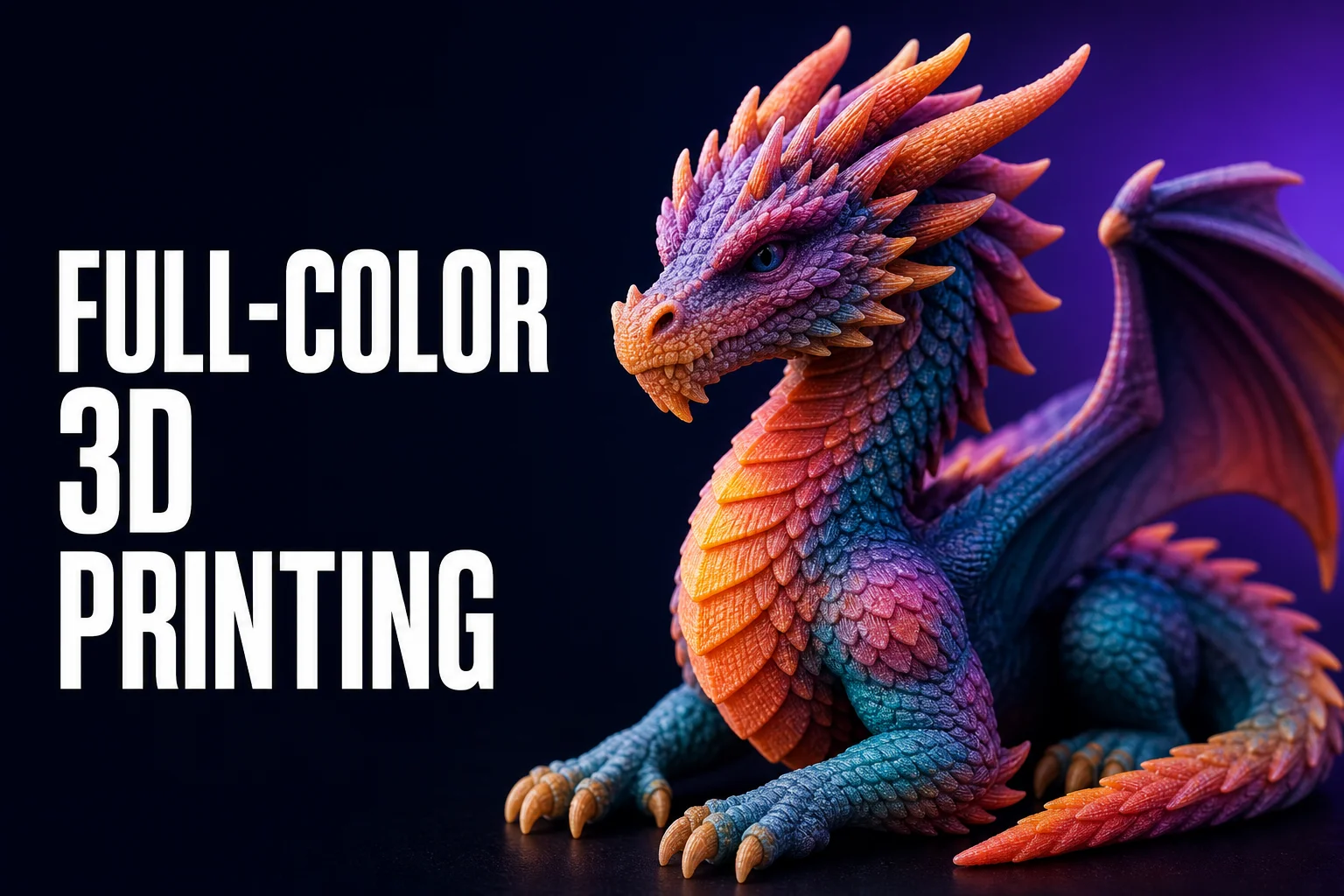
Ten years ago, getting a colored custom figurine meant printing a white model, then paying an artist to hand-paint it — weeks of waiting, hundreds of dollars. Today full-color 3D printing collapses all of that into a single print: color literally grows with the model. This process revolution is reshaping the entire custom figurine industry, turning personalized hand-crafted figures from a niche hobby into an everyday consumer product accessible to everyone.
What is Full-Color 3D Printing? Core Technology Explained
Traditional 3D printing handles one material and one color per run, with color added manually afterwards. Full-color printing (led by PolyJet and color binder jetting) jets colored material layer by layer — like an inkjet printing a photo — producing objects in millions of colors straight off the machine.
The core advantage lies in the simultaneous deposition of structure and color information. The print head dispenses both material and color pigments at each layer, eliminating the traditional multi-stage pipeline of "structure (white base) → painting (manual) → finishing." The entire product emerges in one production cycle.
For figurines, that's a step change:
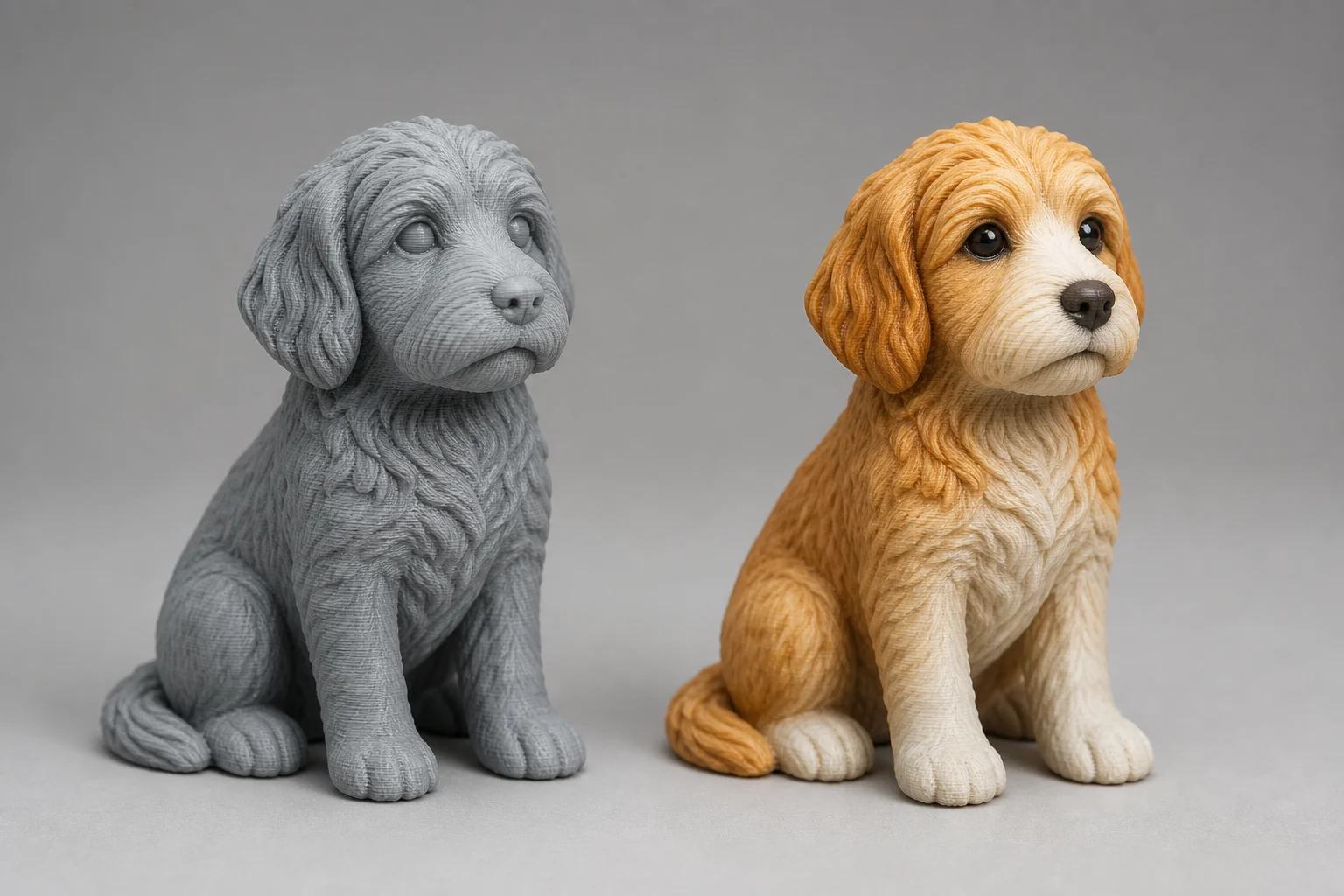
- Natural gradients — pet fur transitions and blushes render smoothly without the visible brushstrokes of hand-painting
- Color as detail — eye highlights, fabric textures, skin tone gradients are no longer bottlenecked by hand-painting precision
- Consistency — hand-painting 100 pieces creates 100 subtle variations; full-color 3D printing produces 100 optically identical pieces suitable for commercial QC standards
Industry Timeline: From Lab Prototype to Consumer Product
Full-color 3D printing is not a brand-new invention—it has undergone decades of technical refinement and cost optimization:
- Early 2010s: PolyJet and similar technologies served industrial prototyping, medical imaging, and engineering sectors. Equipment costs reached into the millions, and finished products often exceeded hand-painted alternatives in price.
- 2015-2018: Material costs dropped annually. Private 3D printing service bureaus began purchasing color-capable machines at scale. Consumer-level color figurines emerged, but prices remained in the hundreds of dollars.
- 2020-2023: Cloud-based AI modeling technology matured. Individual custom figurines shifted from "requiring a deposit and waiting in queue" to "upload and get instant preview." Full-color figurine pricing dipped below $100 for the first time.
- 2024 onwards: Converged maturity across AI generation, full-color printing, and logistics. Color figurines transitioned from "niche hobby in tier-1 cities" to "accessible nationwide mass consumption."
This trajectory embodies classic technology democratization: the core technical breakthrough didn't happen recently, but scale, process automation, and supply-chain optimization transformed yesterday's "premium tech product" into today's "everyday commodity."
Beyond Full Color: A Spectrum of Materials
Full color is one answer among several. Different user segments have distinct material preferences:
| Material | Best For | Characteristics |
|---|---|---|
| Full-Color Resin | Pet figurines, realistic portraits | Rich colors, strong visual impact, lifelike detail |
| White Monochrome | Minimalists, DIY painters | Sculptural quality, artistic restraint, custom-paint canvas |
| Translucent Resin | Decorative objects, light-play art | Crystal-clear, ethereal ambiance, unique with backlighting |
| Stainless Steel | Collectors, permanence seekers | Metallic weight, corrosion resistance, heirloom potential |
AnyMade offers all four materials in the configurator with real-time pricing and preview, letting users choose based on aesthetic preference and budget.
How It Changed the Industry Landscape
1. Price: From Thousands to Dozens, Then Single-Digit Dollars
Eliminating manual painting labor pushed custom color figurines into impulse-purchase territory. For a standard 5cm full-color figurine:
- 10 years ago: thousands of RMB — model cost plus hand-painting premium
- 5 years ago: hundreds of RMB — outsourced production with batched painting
- Today on AnyMade: ¥59 ($9.9) — fully automated pipeline at scale
This price collapse reflects three converging forces: exponential equipment cost decline, complete process automation, and platform-level economies of scale.
2. Lead Time: From Weeks to Days
Painting vanishes entirely; production time becomes pure machine time:
- Hand-painted pipeline: Design discussion (2 weeks) + sample revisions (2 weeks) + production (2–4 weeks) = 1–2 months total
- AnyMade standard: Production 4–7 days, expedited available
- Logistics: Free shipping within mainland China, multi-country international delivery; typical hand-to-hand delivery 10–14 days after order
3. Barrier to Entry: From Professionals to Everyone
Custom figurines previously required:
- Strong visual communication skills to brief a sculptor
- Personal connections to find a reliable modeler
- Prepayment tolerance through multiple revision cycles
Combined with AI modeling, that barrier evaporates entirely:
- A single photo is the entire creative input — everyday snapshots of pets, people, or collectibles convert directly
- Both design and manufacturing gatekeeping disappear simultaneously
- Even without a photo, a text description can trigger creation
This means custom figurines evolved from "hardcore fan and hobbyist privilege" to "accessible personalization for the mainstream."
The Engineering Reality: What Challenges Full-Color Printing Actually Faces
While full-color printing seems to offer "one-shot finished product," the process confronts several engineering realities worth understanding:
Color Accuracy and Gamut Limitations
Full-color printing achieves its millions of shades through pigment mixing, but within hard physical limits:
- Material color gamut: The resin base's achievable color range has a ceiling. Certain extreme saturations, metallic finishes, or neon-equivalent hues cannot be 100% reproduced by any resin technology.
- Screen-to-object perception gap: How an image displays on an RGB monitor differs from how the same colors appear on physical resin by 5–10% due to material reflectivity and light absorption. This is physics, not a defect.
AnyMade's design philosophy centers on "the preview is the blueprint" — if the on-screen preview doesn't satisfy you, regenerate or re-upload rather than hoping the physical output will surprise you favorably.
Structural Integrity and Overhang Design
While resin is mechanically adequate for daily handling, certain geometries pose manufacturing challenges:
- Ultra-thin features (fine swords, hair strands): At small scales (5–10cm), these simplify slightly to prevent fracture during shipping and handling. This is intentional structural engineering, not cutting corners.
- Large unsupported spans: Geometry may be adjusted or users encouraged to upsize to guarantee stability.
These are physical manufacturing constraints, not platform arbitrariness.
When to Choose Full-Color: A Practical Guide
Ideal Full-Color Applications
- Pet and animal figurines: Fur gradients, eye highlights, pad texture—full-color's strengths on full display
- Realistic portraiture: Skin tone depth, fabric patterns, accessory detail — realism is maximized
- Collectible replicas: Recreate source material's color information in one cycle, bypassing multi-round hand-painting revision
- Gift giving: Consistency guaranteed; no "sculptor's mood variation" affecting quality across identical orders
Better Served by Monochrome or Alternatives
- Minimalist aesthetic: White's sculptural purity and negative space speak to certain tastes
- DIY painters: The satisfaction and creative ownership of hand-painting a white base often outweighs instant gratification
- Heirloom collecting: Stainless steel's metallic character and time-resistance suit multi-generational keeping
- Extreme micro scale (2–3cm): Color fidelity suffers; white's simplicity becomes elegant
What Real Users Ask About Most
Market observations reveal recurring concerns among full-color buyers:
- Color permanence over time: Indoors without direct sunlight, color stability holds for years without noticeable fade; prolonged strong sunlight (6+ continuous hours) can cause 5–10% drift over 3–5 years. Glass display cases or opaque shelving preserve color longest.
- Feel and durability: Resin feels smooth, won't chip like ceramics. Casual bumps and office-desk handling don't damage it. Suitable for desks, shelves, and casual rotation.
- Production transparency: AnyMade's order page provides real-time status updates and 360° model preview. Users can track production at every step and even perform a final visual confirm before physical printing—complete agency over the outcome.
FAQ
How long does full-color 3D print color last?
Under normal indoor conditions (no direct sunlight), years pass without noticeable fading. Prolonged window placement under strong light may cause slight color drift over 3–5 years—this is resin material behavior, not a process flaw. Display cases and opaque shelving extend color life indefinitely.
Should I choose full-color or hand-painted?
- Full-color wins on: Cost (tens vs hundreds), lead time (days vs weeks), consistency (identical across orders), fine detail fidelity
- Hand-painting wins on: Artistic range (can transcend material limits), one-of-a-kind expression, collector-grade pieces
- Recommendation: Most consumer orders → full-color. Museum-quality art and unique collector pieces → hand-painted.
What size range is available?
AnyMade supports standard 5, 10, 15, 20cm, and custom 2–30cm. Larger pieces require proportionally longer print time (1–24+ hours) and cost more. First-time buyers typically start 5–10cm; experienced users explore larger custom scales.
What's the price difference between full-color and white monochrome?
At 5cm, full-color is ~¥59; white monochrome saves 20–30%. However, factoring in external hand-painting costs (if desired on white), full-color delivers better total-cost-of-ownership. For a DIY painter, white is more affordable to start.
Can I see the real print progress on my order?
Yes. AnyMade's order page updates with live production status. Once printing completes, the preview switches to a 360° model view. Many orders allow a final pre-ship confirmation, giving users complete visibility and veto power over the outcome.
What if my figurine arrives and the color is slightly different from the preview?
Screen-to-physical color shifts of 5–10% are normal due to material properties and light reflectivity. AnyMade's design emphasizes screen preview accuracy, but if a received piece deviates significantly from preview, customer support is available to evaluate and resolve.
Ready to see full-color in action? Upload a photo to watch it transform into a million-color physical object in your hands. Or browse the Inspiration Gallery to see how other creators used the platform, then try a "Make This" figurine directly.
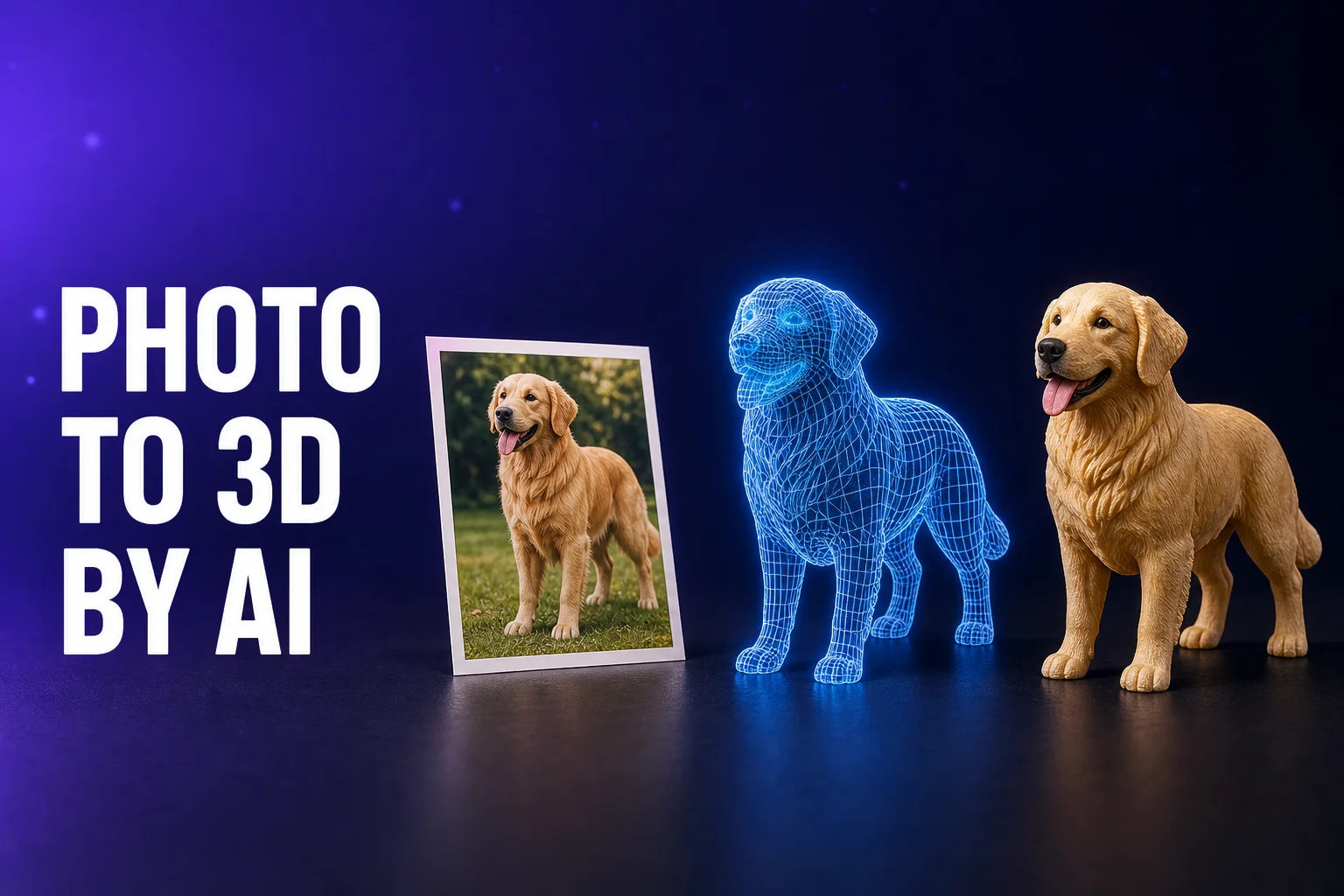 Photo to 3D Model: How AI Generation Makes Personalized Figurines Possible